Int’l Year of Woman Farmer: Bangladesh perspective
 Farida Akhter || Thursday 09 July 2026 ||
Women constitute around 58 per cent of the agricultural labour force. | UBINIG
THE United Nations declaration of 2026 as the International Year of the Woman Farmer is timely and politically significant. It recognises what rural communities have always known, but official systems continue to overlook: women are central to agriculture and agrifood systems. They remain largely invisible in policy, statistics, land records, credit systems, extension services, subsidy mechanisms and decision-making.
For Bangladesh, the year must not become another ceremonial observance. It must be used by the government, the Food and Agriculture Organisation, UN Women, the International Food Policy Research Institute, the World Food Programme and development partners to correct a structural injustice: women produce food, preserve seeds, care for livestock, process fish, maintain homestead nutrition and sustain agroecological knowledge, but they are rarely recognised as farmers in their own right.
The issue begins with the definition. Who is a woman farmer? In Bangladesh, the answer cannot be limited to women who own agricultural land or cultivate crops. Women farmers include crop producers, seed keepers, homestead gardeners, livestock keepers, poultry rearers, fish workers, shrimp and crab workers, processors, fish net makers, food preservers, traditional knowledge holders, wage labourers, rural entrepreneurs and many other women in indigenous communities. Any policy that defines farmers only through land ownership or household headship will exclude millions of women.
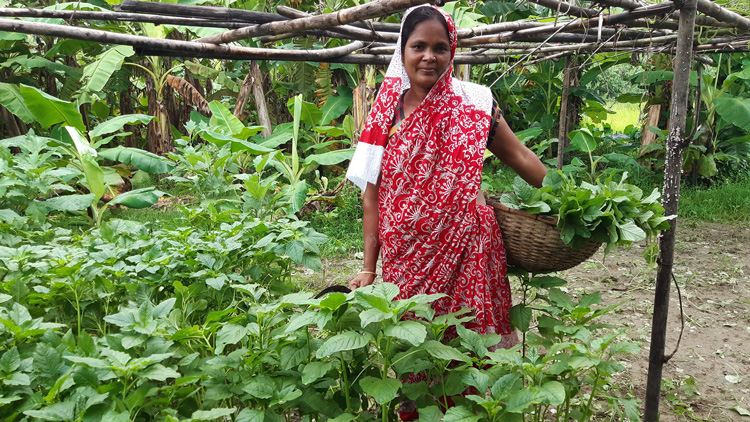
The evidence is clear. The Labour Force Survey 2024 of the Bangladesh Bureau of Statistics recorded 17.25 million women engaged in agriculture, compared with 13.62 million men. Women constitute around 58 per cent of the agricultural labour force, ie, more than men. Yet, this massive contribution is not matched by rights, recognition or access to public support. Women remain indispensable in the field but invisible in the system.
This invisibility is not accidental. It is produced by patriarchy and maintained through male-dominated policy design. Most married women in rural areas are in farming households but are identified as ‘farmers’ wives’ and, therefore, excluded from being recorded as ‘farmers.’ None of the farming work can be completed without women’s contributions. Studies show women actively participate in pre-sowing, post-sowing, harvesting and post-harvest operations as well as growing vegetables and fruit primarily for family consumption, caring for poultry and livestock, supplementing families’ nutrition and incomes through raising kitchen gardens and so on.
Without these activities, farming is incomplete. Yet, women’s labour remained unpaid, undocumented, and treated as family duty rather than productive work.
Because recognition is tied to male-oriented activities outside the household, land titles, market relations, and other formal registration systems, women are excluded from farmers’ cards, fishers’ cards, subsidies, agricultural credit, training, insurance, input support and market programmes.
Land is a major barrier. Women’s agricultural land ownership remains minimal, often estimated at around 13 per cent. But, limiting recognition to land ownership is unjust and analytically wrong. Women’s farming roles extend far beyond titled land. In many rural households, women manage livestock, poultry, homestead gardens, seed selection, food processing and nutrition. For land-poor and landless women, especially widowed, divorced, abandoned, elderly and char-dwelling women, goats, cows, ducks, chickens, fish culture and small-scale processing are their main productive assets and they also own these animals and birds. These women must be recognised as farmers in their own right. If necessary, the policy documents must revise the definition of ‘farmers.’
Among the 1.2 million people engaged in inland water fishing, around 10 to 12 per cent are women. The others are unrecorded. In aquaculture, 60 per cent of the three million fishers are women. In the rural and coastal areas, 30 per cent of all women are directly or indirectly engaged in small-scale fisheries, primarily in aquaculture, shrimp culture, fish processing and net, gear and craft making. Women are not involved in active fishing from the sea, but accompany men in fish production from inland water bodies.
In the livestock sector, over 14.5 per cent of the population is engaged; among them, over 60 per cent of small and older cattle farms are run by women. Besides, there are innumerable land-poor farmers and landless women, who are surviving on raising of livestock and poultry. Poor widowed, divorced and other women raise cows or goats in villages and particularly in char areas. Women’s contribution to both fisheries and livestock is enormous and make a complete picture of what woman farmers contribute to the agrifood systems.
FAO’s inclusive framing of women farmers is, therefore, highly relevant for Bangladesh. It recognises farmers, producers, peasants, family and smallholder farmers, seasonal labourers, fishers, fish workers, beekeepers, pastoralists, foresters, processors, traders, traditional knowledge holders, women in agricultural sciences, formal and informal workers and rural entrepreneurs. Bangladesh should adopt such an inclusive definition immediately for national policy, registration and programming.
From an agroecological perspective, women are not marginal or invisible actors, they are central to the resilience of farming systems. Women select and preserve seeds, care for livestock, provide materials for composting, manage homestead gardens, maintain crop and food diversity, process foods and preserve uncultivated greens, herbs, fruit and medicinal plants. Their knowledge links biodiversity, nutrition, health and household food security. If Bangladesh is serious about agroecology, climate resilience and food sovereignty, women farmers’ role in agriculture must get its due recognition and must be placed at the centre of agricultural transformation.
Climate change makes this recognition urgent. Women farmers, fishers, livestock keepers, and processors face the direct impacts of river erosion, salinity, cyclones, drought, landslides, erratic rainfall and drinking water scarcity. Women in char areas face displacement. Women in coastal areas face soil, water and crop salinity as well as livestock and household health issues. Women in hilly areas face landslides and loss of cultivable land. Climate policy that does not recognise women as farmers will fail.
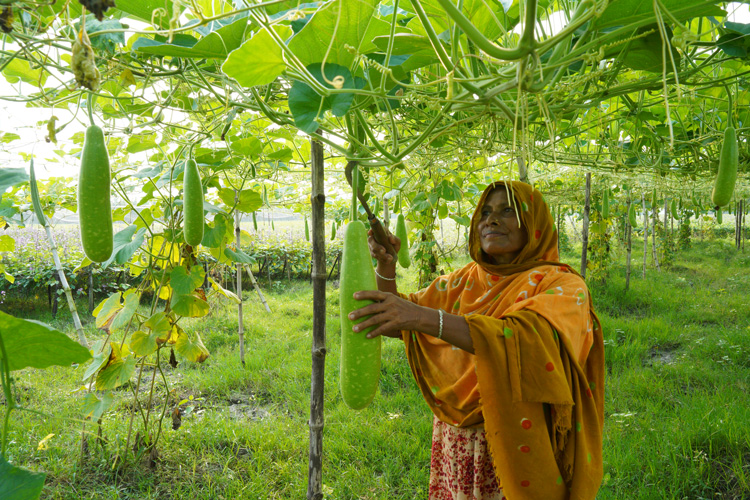
There is another UN initiative, ie International Day of Rural Women, celebrated every October 15, on the eve of World Food Day, October 16. This has been an important day for women farmers which was resulted from the women’s demands globally at the Fourth World Conference on Women held in Beijing, China in 1995. It was suggested that October 15 be celebrated as World Rural Women’s Day to highlight rural women’s role in food production and food security. World Rural Women’s Day was celebrated worldwide for more than a decade, even before becoming an official UN observance in 2007, following the UN General Assembly’s adoption of Resolution 62/136. This long journey of rural women vis-à-vis women farmers must be integrated together this year on October 15 as a nationwide celebration of women farmers as part of rural women.
Therefore, the government and the Food and Agriculture Organisation should use the International Year of the Woman Farmer 2026 to launch a concrete national agenda rather than a symbolic campaign. Male-dominated and top-down policies leave women out of many decisions affecting their lives and livelihoods. The International Year of Women Farmers must show demonstrative plans and actions for women to be reflected in the government programmes and actions. There must be a visible political will and commitment from the government to recognize women farmers in their own rights . The the International Year of the Woman Farmer must not become a ceremony only. It should continue more and be reflected in International Day of Rural Women every year. Food production, processing up to the market will not be possible without well organised and strong women farmers with fulfilment of their rights. It is a question of food sovereignty for the 170 million people of the country.
Women’s marital status must not make her ‘disappear behind male head of households’ and also should not make those ‘not currently in married category’ (ie, divorced, widowed, abandoned) to become special recipients of supports without recognising their contribution with honour.
The agricultural database must be sex-disaggregated on the basis of contribution to crop production, fisheries, livestock and all other works in agrifood systems.
Labour force numbers do not represent all women’s work. Many of them are self employed. The state must document women’s work in seed keeping, livestock, poultry, fisheries, aquaculture, homestead production, processing, storage, marketing support and wage labour. Without data, women will continue to remain invisible; without visibility, there will be no policy justice.
The the International Year of the Woman Farmer 2026 must connect with the International Day of Rural Women on 15 October and World Food Day on 16 October. These observances should become annual accountability moments where government agencies report what changed for women farmers: how many received farmers’ cards, how many accessed credit, how many joined extension programmes, how many gained access to land or water resources, and how many were included in local decision-making.
Women farmers must be recognized as central to food sovereignty. Bangladesh cannot ensure food security for 170 million people while ignoring the women who produce, process, preserve, and sustain food systems. Recognition is not charity. It is justice. It is also sound policy.
The International Year of the Woman Farmer 2026 offers Bangladesh a historic opportunity. The country can either celebrate women farmers in speeches and leave the patriarchal system unchanged or it can use this moment to reform agricultural policy from the ground up. The choice is political.
If Bangladesh wants resilient agriculture, safe food, strong rural livelihoods, biodiversity, nutrition security and climate adaptation, it must recognise women farmers as farmers. Not as helpers. Not as farmers’ wives. Not as welfare recipients. As producers, knowledge holders, rights-bearing citizens, and leaders of agrifood transformation.
The International Year of the Woman Farmer 2026 must, therefore, become a year of recognition, rights, resources and representation for women farmers in Bangladesh.
Farida Akhter is executive director of UBINIG (Policy Research for Development Alternative) and former adviser to the fisheries and livestock ministry of the interim government.
Originally published in a National Daily New Age on 08 July, 2026. (Int’l Year of Woman Farmer: Bangladesh perspective)