Fertilizer, fuel & machine-dependent Agriculture: Crisis is Just the Beginning
 Farida Akhter || Thursday 18 June 2026 ||
Aggressive attack by the USA and Israel on Iran was held at the end of February this year, the shock is being felt in Bangladesh as well. The attack is on or off; but the long queues for bikes, cars, buses, and trucks at oil pump stations in Dhaka, district towns, even in upazilas, indicates whether the Strait of Hormuz is open or closed. Many Bangladeshi expatriates in Arab countries are returning to Bangladesh as dead bodies, while many others have been unable to go due to a lack of a valid visa to Arab countries. A dire fuel crisis, whether artificial or real, prevails in the country. We are distressed because the lives and livelihoods of many people are linked with this. In addition to the fuel crisis in the cities, there are other burning issues in the news indicating its impact far in the villages; again, the farmers have fallen victim to the crisis. None would have cared to mind if the news of farmers dying in queues for fuel was made public.
The fuel crisis has affected farmers in various ways. Even though the news published in newspapers is city-centered, the district correspondents have also well covered the remote areas. It was revealed that irrigation for various crops, including boro rice, was severely affected. The farmers have been collecting diesel by standing in long queues at the filling stations. Many times, they have been forced to collect fuel from the retail market at a higher price.
Rice, mango, vegetables, and jute production were supposed to be covered by irrigation, but could not be provided for lack of the required fuel energy. The diesel price has gone up; consequently, production costs are increasing. Now it is the time for boro rice. Generally, this time the farmers apply irrigation. Irrigation activities are interrupted due to the non-availability of diesel. Rice in many fields has been wilted for want of timely irrigation.
Starting from the seed bed of aus rice, land plowing, laddering, and the machines used for rice harvesting are mainly dependent on diesel, and this dependence has aggravated the plight of the farmers.
There was enough rain in Chaitra (mid-March to mid-April), the aus rice farmers were happy. It has been raining in Baishakh (mid-April to mid-May) as well. But the landowning farmers are unable to run tractors for want of diesel to cultivate aus rice.
Boro rice farmers have started harvesting rice in the haor area from the beginning of Baishakh (mid-April to mid-May). Rice is harvested simultaneously in the haor area. However, there is a scarcity in the supply of fuel for combined harvesters, threshing machines, and transport for carrying harvested rice from the field to the threshing floor.
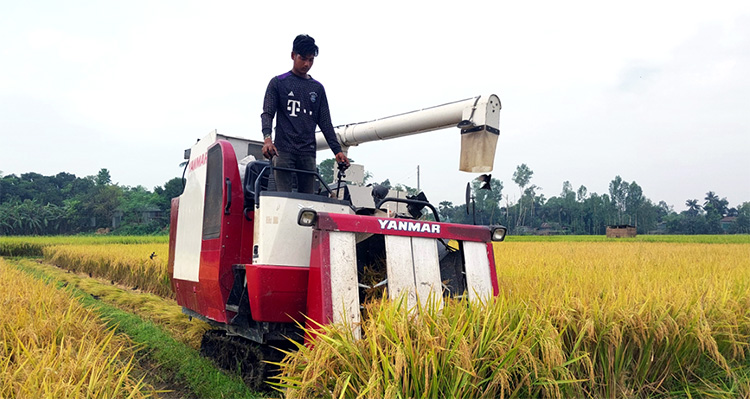
Fairidpur is one of the most important region for jute production. Due to the serious diesel crisis and irregular electricity supply, land preparation and jute seed sowing were badly affected. Consequently, jute production may be affected in an unusual way.
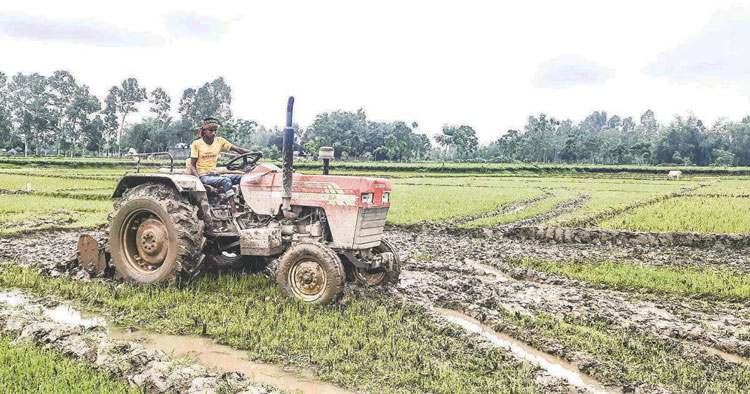
In agriculture, diesel is mainly used for irrigation; however, electric irrigation machines are also available. In addition, diesel is used in power tillers and tractors. Diesel is also used in paddy threshing and combined harvesters. Many farmers use a tractor and a power tiller for rice production. It is learned from newspaper reports that farmers with a number of tractors go to filling stations to fill only 10 liters of diesel to run one tractor, keeping the others idle.
The sufferings of the mango farmers are no less. In this season, there are buds on mango branches. The mango farmers shared with the newspaper reporters that each farmer needs 10/12 liters of diesel daily to save mango buds. But they are not getting this quantity of diesel. Some of them could not apply any irrigation to the mango grove. Again, the cost of mango production has been rising due to higher fuel prices.
Has this crisis cropped up only because of the war in Iran? Definitely not. The war in Iran has just starkly highlighted the symptoms of fossil fuel dependency. Such hue and cry we have experienced on different occasions, even before the Iran war.
We can feel the root of the problem if we look back a bit. At about the end of the 1960s and the beginning of the 1970s, so-called “modern agriculture,” based on chemical fertilizers, pesticides, and irrigation, was imposed on the farmers of the newly independent Bangladesh by the World Bank and other international agencies. It has been given a figurative name, “Green Revolution”. At the beginning of modern agriculture, it was characterized by specialization, a package method.
The seed must be HYV/hybrid, accompanied by chemical fertilizers, pesticides, and irrigation using a deep tube-well. The soil across Bangladesh and the natural environment are not identical, but they were made the same in modern agriculture. Irrespective of land type, high-low and all-over must be covered by irrigation. Modern agriculture did not halt here. Gradually, mechanization started. Tractor/Power tiller replacing wooden plow drawn by bullock, rice harvest, threshing, etc., did not remain in the hands of the farmers. The machine is serving all. The more the mechanization, the more modern. However, agricultural mechanization mainly depends on fossil fuels (diesel) and electricity. Here, the main problem arose. The different regimes in power might have differing opinions on various issues, but had no differences regarding the mechanization and modernization of agriculture. The change of government did not alter agricultural modernization and mechanization. The reason is simple and plain: the World Bank, ADB, and other international authorities are behind the introduction of modernization and mechanization of agriculture. The government is also giving subsidies in this type of agriculture. Supporting farmers means providing subsidies for fertilizer, pesticides, and irrigation. Not only these, but there is also an entry of multinational companies dealing in chemical fertilizers, pesticides, and machinery. Mainly, they have been entering the market for their products through farmers in our country. Now, in 2026, there is a war in Iran; consequently, there is uncertainty in fuel supply. And the farmers are directly affected. This situation is seen in other Asian countries as well. The fuel crisis is directly affecting irrigation and tractor use. As a result, rice yields may be reduced during the dry season in Asian countries.
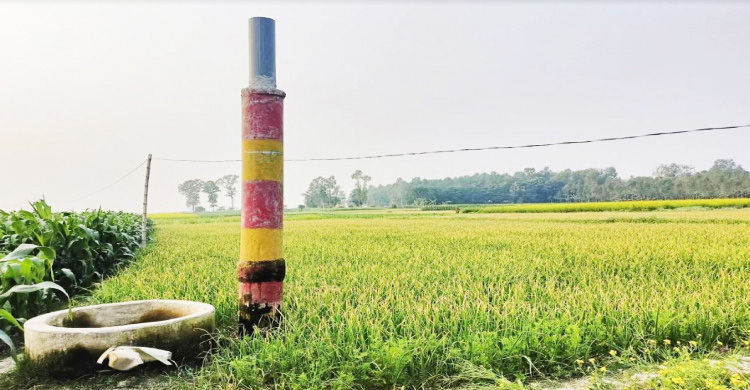
According to FAO data, Bangladesh is the third-largest rice-producing country after India and China. Rice is grown in Bangladesh in three seasons: aus, aman, and boro. Aus is in the beginning of the rainy season (Chaitra-Baishakh-mid-March to mid-June), end of rainy season, and the autumn Aman rice is grown (Asar-Srabon) mid-June to August. And in the winter, Boro rice is grown (Agrahayan-Magh) from mid-November to mid-February. Among these, Boro rice is grown in the dry season, so it is dependent on irrigation. Chemical fertilizers and pesticides are definitely needed. In modern agriculture, boro rice has become the main rice season, whereas previously, Amon rice was the most important. At present, boro rice accounts for 55-60%, aman rice for 38-40%, and aus rice for 6-8%. Such change is bringing more problems than solutions.
Rice is the main crop of Bangladeshi farmers. High-yielding varieties (HYVs) of rice laid the foundation for modern agriculture. The farmers cannot get out of the crisis of fuel dependence, those who have been practicing modern agriculture and growing boro rice as the main season of rice production. The entire agricultural production is dependent on fuel. All operations from land preparation, irrigation, rice harvest, and rice threshing have been fuel dependent. Except for rice harvest and threshing, no other practices can be performed without a machine. Moreover, in modern agriculture, the type of seed has been changed; only HYV and hybrid seeds are used in the boro season of rice production.
In the past, only the local varieties of boro rice were grown in the lowlands in the dry winter season. The main varieties of boro rice include Dhepa boro, Balam, and Rata. There was no need for fertilizers, pesticides, or irrigation to produce local varieties of boro rice. At present, only HYV and hybrid rice varieties are grown in the haor areas.
BRRI dhan 28 and BRRI dhan 29 are grown in large areas. Pesticides, chemical fertilizers, irrigation and all other modern technologies are used. During the rainy season, when haor areas are inundated, chemical fertilizers and pesticides used in rice fields pollute the environment and severely damage the fish population. Water is essential for rice production, which may be obtained from rainwater or lowland water. However, after making boro rice the most important crop, not only in the lowlands but also in both the high and lowlands across the country, rice is grown with irrigation. Boro rice is not supposed to be grown in areas with water problems.
Boro rice production has become risky in the Barind region (Rajshahi, Naogaon, and Chapainawabganj) as groundwater levels have been declining. Here, deep tube well owners charge poor farmers a higher price for irrigation water. The cases of farmers’ suicides have occurred due to the higher cost of rice production.
So it is not the war, but the imposed dependence on fossil fuel, electricity and mechanization, which made the crisis deeper. It will not be solved by ending the war. The crisis has just begun.
Originally published in a National Daily Samakal on 4 May 2026. This is a translated version. Translated by Dr. M . A. Sobhan
আধুনিক’ কৃষিতে জ্বালানি সংকটের গোড়ার কথা