About UBINIG
UBINIG
UBINIG is a policy and action research organization in Bangladesh, formed in 1984 by a group of activists to support peoples' movement for social, economic, political and cultural transformation. It satrted as a study circles searching for alternatives to the mainstream development intervention. The objective was to make policy making oriented to people and the process more transparent and inclusive serving the interest of the majority of the people.
For us the re-search is a form of social activity that we use to achieve collective objective, and not to represent the 'other' as an object of study. We implement our observations, analysis and ideas in various community programmes. We are involved in our communities, in many different ways to transform the present for a positive future. In bangla, such engagement is known as creating conditions for the samaj to arrive. The ‘samaj’ literally means a community where every person develops equallly and harmoniosly with others. In short, our development practice is to resolve the contradiction and anatagonism our communities are facing in a globalised world.
Our Principle
In simple words, our principle is to celebrate life. Life is beautiful both as nature and as spirit, evolving for millions of years as natural history and continued as the history of human communities culminating to the present point where we have a real possibility to articulate, celebrate and demonstrate the beautiful in us. We believe we can do it.
From the premise of this intense realisation we organise our activities according to the following five principles:
- Caste, class, patriarchal, economic, political or cultural hierarchies and oppressions of any forms are not acceptable including politics of identities based on religion, ethnicity, biology, language, culture or others. Nevertheless, diversity within and among communities must be celebrated. we work relentlessly to generate new contexts where hierarchies, inequities and exploitations are impossible and so will be gone the premise for politicisation of difference.
- Avoid and reject if necessary, overused and abused terms and discourses that have already been displaced from its intended meaning and has become a political tool for both low intensity operation and violent interventions in our communities, such as ‘development’, ‘growth’, ‘democracy’, ‘socialism’, ‘rights’, ‘gender’, etc., but only with the unshakable commitment to retain the value of the original project they all signify in various ways: celebrating the human spirit of freedom and joyful living. No force on earth could ever overturn this project – we must be the bearer of the torch.
- Language and culture is the crucial area of work. Discover the global and the universal in local language, history, culture and various forms and struggles of the peoples and communities and not the other way around; beginning ‘globalization’, a very common practice, marginalises, distorts and undermines the local. Identify the areas of convergence as well as conflicts, antagonism and resistance. Global transformation begins at the level of local ideas and discourses when local communities develop capacity to articulate and reject what they consider wrong and assimilates what they consider positive in their own languages and in their own cultural context – global begins to appear in a community.
- Defend and practice a lifestyle consistent with the principle we have adopted collectively but remaining respectful and responsible to others – peoples’ opinions, activities and diverse lifestyles. Never consider at any moment that we have the universal truth for every one to follow, there is nothing of this sort. Nevertheless, there is always something called that task of doing the right thing at the right time.
- World is a gift to be cared and preserved and remain ethically committed to defend this value; we do not accept the consumerist illusion that world exists only for human beings, for consumption and destruction. The world is not simply ‘industry’, a means to make money, or only a source of raw materials. The space, honour and integrity of each and every entity have sanctity and meaning.
Our Work
Registered in 1984, UBINIG started its Dhaka office and since 1990 has been operating at the community level through Biddaghors or (Learning Places) in various districts of Bangladesh. These Biddaghors play very important role for our self-education; they are also powerful community means to undertake community-led research and practical actions.
We live and work with local communities; living, learning and interacting together is our strength; interacting with communities in real life situations and becoming the community is the most valuable empirical and social foundation of our investigation, analysis, knowledge formation and advocacy.
Research, Campaign & Advocacy
Since its inception UBINIG, as a research, advocacy and campaign organisation has been engaged in policy research and analysis based on evidence-based claims and empirical findings.
Our active policy of being involved and gradually becoming an integral part of the local community provides us greater understanding of local realities, contradictions and antagonism in the context of increasing integration of local into the global. For us research is a challenge to translate experience into ‘formal’ or ‘informal’ language that could be shared and communicated with multiple users. Before a research is undertaken, a mapping of the potential users of research results is usually done. We use various research ‘tools’ or methodologies depending on the purpose of the research and its potential use. We are aware of piracy and privatisation of local and indigenous knowledge for intellectual property rights and therefore resist those acts. Our research is for the communities with whom we live and for whom we work and this is the fundamental principle of our relationship with other research organisations and partners.
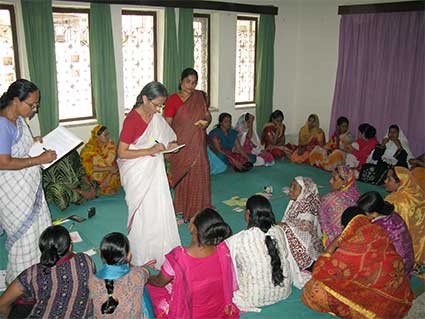
Reseach is still a major activity of UBINIG. However, contrary to the the dominant idea of research that make a community an 'object' of study, UBINIG research is geared to empower the community. Such approch dissolve the so called 'researchers' into the collective proceeses of knowledge genration. 'Participatory' is not the right word to express this practice of collective knowledge generation. UBINIG is a practioner of Social Analysis System. Here in the picture the garment workers are collectively generate a process of knowledge producton that in way that strengthen their effort to improve their own health and chart a strategy t influence government policy o health.
UBINIG is deeply interested in oral knowledge and the ability of social memory in retaining valuable scientific data, wisdom and practice. By our long experience of working with oral cultures we are convinced that orality and literacy is not a case of one or the other; both are equally important for knowledge production. Erosion of orality is an irreversible damage done to our faculties to learn and produce original ideas.
Combination of community activity, setting structures and processes to generate original ideas and knowledge and the capacity to implement new ideas have become the prominent qualitative features of UBINIG.
UBINIG is collaborating with a Research initiative Social analysis System2 (SAS2) which offers a new approach to creating and using knowledge for the common good coordinated by Carleton University (Canada) with a number of institutional partners around the world.
UBINIG gets involved in various national, regional and international campaigns. Issues are identified through research, workshops or seminars or triggered by the movements of farmers, weavers, women or other social actors with whom UBINIG works.
Innovating Institution
UBINIG operates organisationally as a family. We work collectively, share our thoughts collectively and therefore the accomplishments are shared in a collective manner.
UBINIG is an innovative exercise in institution building. We are determined to demonstrate that people get motivated and take responsibility to contribute to the needs of the people and communities around them. Working in the community and for the community is not a ‘job’ or ‘employment’, it is a commitment.
Transparent and collective process of decision making and strict implementation of collective decision is the heart of the organisation. Responsibilities are divided according to capacity. Each and every member enjoys opportunity to be trained and there are scopes for education. Leadership position is not a management decision, but the result of collective endeavour, trust, experience and quality of organisational ability.
Defending lifestyle
Agriculture and the agrarian lifestyles, community creativity are major areas of our work. We work to defend agriculture as a way of life and not only a sector of production of ‘food’, and never for profit.
Defending lifestyles has also direct implication for communities and cultures dependent on forest. We, therefore, also work closely to conserve our forests and lifestyles of indigenous communities.
i. Nayakrishi Andolon: Agriculture as a Way of Life
(New Agricultural Movement) is by now a major ecological movement in Bangladesh involving over 300,000 farming families (as of October 2009). The strategic focus of agriculture at present is biodiversity and genetic resources. The Nayakrishi distinguishes its practice from commonly familiar ‘organic’ agriculture for various reasons. Emphasis is on the biodiversity based life activities, developing an operational notion of ‘ecosystem’, ensuring various natural cycles of water, elements, nutrition, energy, evolution and demonstrating the validity and authenticity of experiential knowledge. These are some key features that distinguish Nayakrishi practice from commonly known ‘organic’ agriculture.
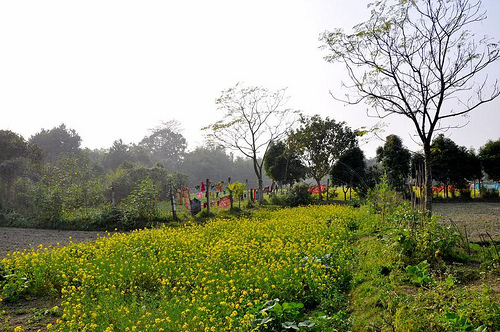
Nayakrishi Andolon is not simply about production of ‘food’ but regeneration of communities with conservation and enhancement of their wealth for healthy, happy and enriched life.
Nayakrishi bases itself on the experiential processes of learning and judges all knowledge-claims and statements on the basis of its own practice, but remaining conscious of its own limits.
Nayakrishi Andolon, therefore, is an open learning process. It learns from anybody, everywhere and from anywhere. Nayakrishi over the years learnt intensively and extensively from various renowned approaches. It learnt from Permaculture, Bio-dynamics, Fukuyaka, ancient Indian practices of forestry, Ayurveda and home gardens and of various Sufi, Bhakti and Jain-Buddhist systems of practising self-conscious lifestyles to allow the cosmic or unitary energy of nature to express in a particular place and time.
ii. Handloom Weaving, Handicrafts & Community Creativity
Our involvement in handloom weaving and art and crafts was triggered by various factors. Some key concerns are as follows:
We are always interested in craft works and argue that it is important to observe and study closely how market transforms the community creativity into de-skilled labour power for the labour market without jobs. What communities lose and what they gain is important not simply for aesthetic reasons but for grave social and economic implications.
 We developed an operational strategy that could ensure craft weaving to continue and flourish. It is based on a production strategy and simultaneously building relation with enlightened and conscious consumers. The artisan ‘craft’ work is presented as craft -work as such, and not simply a commodity. On the other hand, those weavers who are not skilled in craft are trained in semi-automatic looms for mass production of fabrics and could equally compete in the market but without falling into exploitative relation with the mahajans (moneylenders and commercial traders of handloom fabrics).
The idea of articulated community development that runs on two feet: agriculture and rural industry, is our guiding paradigm.
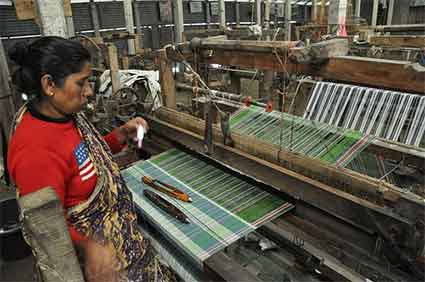
We noted during the early 80's the immanent failure of ‘income generating’ & ‘targeted’ interventions for the ‘poor’. Involvement in weaving activities sharpened our critique of ‘export-oriented industrialisation’ dictated by WB/IMF structural adjustment programmes, ignoring the potentiality of handloom, both for home and world market. It was also fascinating to observe the tenacity and strength of rural handloom entrepreneurs surviving the assault of detrimental policy environment, market liberalisation and ‘protection’ of the spinning and textile mills. We did a thorough study of the sector in 1986 to identify the potentialities in more concrete terms and started to organise weavers. Soon we realised that the handloom sector can play an alternative route to development instead of the export oriented industrial model followed by the government and the international donor communities.
The concern for ecology and environment was also a major factor. The handloom sector is based on renewable energy. The industrialisation process based on large-scale textile and spinning industries uses fossil fuel. The handloom weaving is part and parcel of our ecological agricultural activities and together constitutes the main thrust of our rural regeneration of life, livelihood and prospering relations.
iii. Education: Each and every child is born with unique faculties
Shikhi Pori Biddaloy
Our work with agrarian and weaving communities also reinforced the truth that the existing system of education excludes the poor and the children. Children from farming and weaving families could hardly attend school. Our initial involvement in ‘formal’ education in Dhaka, Tangail and Cox’s Bazaar was triggered by this fact.
Nevertheless, UBINIG over the years became critical of formal education and started to raise question about the purpose, method and content of ‘education’. The literacy itself came under suspicion when we noted that ‘modern’ literacy programmes have serious detrimental effects on the local & indigenous knowledge and the capacity of the community to cope with real life situation. Obviously, the huge development fund used for ‘informal education’, mainly ‘literacy’ and ‘conscientisation’ was equally questionable in terms of their purpose and eventual results.
Secondly, the danger of homogenised curriculum and poor quality education materials became obvious and UBINIG started to rethink the idea of ‘education’ itself on the basis of our experience in community activities. The experience in Nayakrishi Andolon and gradual transformation of our local centres into place of learning, into Biddaghors, offered us some primary clue how we should approach ‘education’. At present UBINIG’s operational approach to education could be glimpsed through the following statements:
1. An education system that reinforces the separation between mental from the manual is elite in nature and socially divisive. The present education system creates a mindset in the ‘educated’ that are colonial, pro-western, anti-people, anti-ecological and intensifies self-interest against collective goal. A thorough analysis through research and meaningful experiments is necessary to chart alternative learning process. We have already started this exercise at the present ‘schools’ run by UBINIG and all our ‘centres’ in the village are slowly being transformed into Biddaghor, (a space for learning and doing as continuous and cyclical process).
2. The present reading, learning, researching, sharing and communicating practices in all Biddaghors is intensified. Allocation of time to learn and reflect is more generously provided to the UBINIG members who are providing physical labours. Study in advanced science such as Botany, Zoology, Ecology, Computer Programming are being offered in more equipped Biddaghors of Tangail, Cox’s Bazar and Ishwardi. Capacity building in science and technology without losing the ground of experiential knowledge processes is now the priority of the organisation.
3. The present ‘school-based’ education or identification of a ‘fixed space’ to teach young students is phasing out. All Biddaghors are gradually transforming into open space where children could learn playfully and having direct association with agriculture, weaving or other activities appropriate for their mental and physical development contributing to their livelihood strategies.
4. The present operational guidelines of our education programmes assume that each and every child is born with unique faculties. The task of ‘education’ is not to manipulate ‘fitting’ and ‘disciplining’ children into the existing social system rather society must learn through children how to create a new future for all.
The idea behind the above practices is not to undermine literacy. It simply means not allowing any privileging status to literate knowledge over oral wisdom and other experiential memories and summations of the community life.
Bridging the divided realm is the most challenging task for UBINIG.
iv. Video & photography skills
UBINIG organised training to farmer women and some of our young male and female colleagues who have no literacy background or have very minimal formal education. The video team has developed skills to produce documentary films on issues related to UBINIG works, particularly biodiversity and livelihood.
These trainings are guided by the principle that the community should have control and command over camera and their representation in the media; this is against the conventional practice of making communities ‘object’ of others and interpreting their life by people outside the community. Photography skills are developed among young members of UBINIG.
v. Culture: Reclaiming the cultural and philosophical history of Bengal
By culture, UBINIG does not simply relate to performing arts, but to popular and critical encounter with dominant ideas of development, science and technology, linear conception of history and the purpose of life as material accumulation represented in money form. Culture is the critique of lifestyles, our mode of relating to the external world and to ourselves. Culture determines how we accept, explain and treat ourselves; it generates positive willing & offers visions for a future creating condition for nurturing positive ethical values for community activities. Broadly, culture is the gateway to the ethical world for UBINIG and a powerful means of community education for social transformation.
Our, present focus is to reclaim the cultural and philosophical history of Bengal through researching the various social and spiritual movements and ethical discourses. These are mostly retained in music, poetry and lyrics.
Nobopran Andolon
Nobopran Andolon is the organisational form for our cultural activities. By now Nobopran is well known nationally and internationally for the collections of poetical and musical discourses of Bengal, originating from the social and spiritual movement for good life, responsibility to others, social harmony and peace and respect to the integrity of life and nature, etc.
It is the platform to do research in oral cultures, local knowledge and discourses on social wisdom expressed in music, poetry, festivals, theatres, congregations and other informal forms. The saintly traditions of Bengal are strongly rooted in ecological visions and strong ethical foundation of social justice. Nobopran is the bridge between oral and literate culture and a powerful means of social education and awareness building.
Nobopran works very closely with Nayakrishi Andolon, firstly because the members of Nobopran are rooted in the village communities. Secondly, the activities of Nobopran have direct implication for Nayakrishi that is struggling to achieve an ecological lifestyles and just society. Thirdly, both are complementary to each other and in fact constitute the eco-ethical foundation upon which movement for social change is strengthened and accelerated.
The members of Nobopran work with the farmer poets. We are working at the cultural level to communicate with the common people and to understand the inherent philosophical content of the society. The songs composed by the poets, saints, etc. are collected for analysis. Musical programmes are organised in the rural and urban areas on various occasions.
Nobopran has started a school for music and arts "Nobopran Shongit ghor" in Dhaka and Kushtia for children as well as for adults to learn basic principles of music and particularly those of Lalon songs.
vi. Dissemination & Campaign
Dissemination of our ideas, research results and advocacy positions are done through various conventional means of seminar, workshops, rally, demonstration, and briefing to journalist and regular writing in national dailies and journals. However, the Pranbaichitra Mela (Biodiversity Festivals) deserves to be mentioned here because of its significance as a dissemination method and policy tool.
Biodiversity Festivals
The Pranboichitra mela (Biodiversity Festival) is an event of Nayakrishi Andolon, held yearly or bi-yearly with weavers associated with Prabartana and with singers associated with Nobopran Andolon. The farmers and weavers take this opportunity to share respective issues of concerns that needs to be addressed. The fishing community also joins with the farmers and weavers.
The yearly Mela is organised in one of the areas in Bangladesh where we have Biddaghors with good organisational abilities. Hundreds and thousands of rural and urban people attend the Mela.
The Biodiversity Festivals demonstrate the rich biodiversity and knowledge of farmers, fishers, potters, weavers and various other communities. When people see that farmers cultivate diverse crops and produce foods without pesticide and chemicals, the impression become very strong. The direct observation triggers series of exciting questions and the whole festival become a festivity of knowing and learning. Farmers demonstrate how the complex and multiple productions of mixed crops are practised not only for diversity but to increase yield. Since food is produced without pesticide or any chemical, the taste, nutritional value and safety issues are communicated more directly.
In the Biodiversity Festivals policy makers, particularly government officials, decision-makers, scientists, media and other important actors of the society are invited. Large mobilisation of the rural people in support of ecology, biodiversity and safe environment is very powerful to convince the policy makers that can not be achieved by spending huge amount of resources in organising seminars or only delivering glossy reports.
The policy makers see the interconnection of rural activities and rural livelihoods, an impression and knowledge difficult to present in textual form.
By demonstrating the alternative practices the farmers also raise questions about the detrimental policies that are destructive to agriculture of Bangladesh and where the reforms must be contemplated. It is an enormously educational opportunity for any one who is interested in ecology, environment, and food security, particularly the issue of agricultural biodiversity.
The weavers through their artisanship and the beauty of the handloom production demonstrate why machines can never copy the ingenuity of human creativity. The farmers and weavers also invite potters, blacksmith, bamboo craft artisans and other professional communities to be with them to show the other dimensions of the diversity, which are part of the production system in the country. In the evenings, there are cultural functions organised by Nobopran Andolon.
Small Festivals
UBINIG regularly organises small festivals such as food festivals, rice festivals, fish festivals, mango festivals, pitha or local cake making, fabrics, etc. in Prabartana, Dhaka and festivities on uncultivated leafy vegetables (shaks), Chaitra Shonkranti or year-ending of bangla calendar, etc. These are open for general public and are very educative with sharing of lot of information.
Our Working Areas
Co-ordinated from Dhaka office UBINIG’s activities are spread over different districts of Bangladesh. We started our Tangail office in 1986, the year we started working with local handloom weavers. Now the centre is co-ordinating both handloom weaving and ecological agriculture among other activities. Tangail centre coordinates the activities in other districts such as Sherpur, Jamalpur, Sirajganj and Kurigram.
We started working in coastal areas since 1987 for carrying out research shrimp fry collectors and later after the cyclone of 1991 started an office for mangrove regeneration. It coordinates other districts such as Chittagong, Noakhali and Chittagong Hill Tracts.
We started working in the northern district of Pabna since 1994 to see the environmentally threatened areas due to excessive use of Deep tubewells. Through the centre in Pabna, Natore, Chapainababganj, Kushtia are coordinated.
Each centre is a Biddaghor, the learning centres. With the increased intensity, depth and spread of our work, more Biddaghors are established.
Our sister organisations
UBINIG inspired various ecological, social and cultural movements. Some movements have transformed the organisation itself. Movements maintain organic link with UBINIG while operating independently: Nayakrishi Andolon, Nobopran Andolon, Narigrantha Prabartana, Dai Samity, Sramabikash Kendra, Prabartana, Shashya Prabartana are some of the examples.
These organisations grew from UBINIG and eventually became independent with their own management system but guided by the philosophy, principle and objectives of the organisation.
Sramabikash Kendra: Defending Worker’s Rights
Sramabikash Kendra is the trade union and development education wing of UBINIG. In English the name translates into “Centre for Labour Education and Development”. It aims to bridge the gap between research and worker’s initiatives to develop healthy environment in trade union activities of Bangladesh.
Apart from trade union and development education, Sramabikash Kendra plays strong advocacy role with regard to policies that affect the lives of workers. It also plays crucial catalytic role in generating discussions and debates, particularly among the general workers and the trade union leaders on the issues of industrialisation and trade union issues.
Since 1986, UBINIG is active among workers with special attention to women. The emergence of female labours in garment sector has been noticed since 1985 but the major inflow occurred during the decade of eighties and continuing until to day. For a long time women-workers remained unnoticed by the development organisations. The workers were not aware of the legal rights to form unions and improve working conditions. There were particular gaps existed in the works of the trade unions to address the question of female workers. The policy of export oriented industrialisation relaxed factory regulations and labour laws. Therefore, it was necessary to understand the situation of the workers in garment industries, shrimp processing industries and informal sector thoroughly to undertake policy measures for improved working condition and factory management as well as to ensure the right of the workers.
The effects of Structural Adjustment and lending policies of multilateral agencies, especially privatisation, deregulation and de-unionisation of the workers of Bangladesh are the key research concern of Sramabikash Kendra. It also monitors the GATT negotiations, particularly Labour Standard debates and Social Clause issues and informs the workers about the possible consequences of liberalised international trade and agreements.
Prabartana
Prabartana is the clearing-house for handloom fabrics and products, handicrafts, pottery, handmade papers, wooden crafts, and various art objects directly related to the ecological livelihood of the people. Started in 1989, it is also the meeting place of socially responsible consumers and the producers. It frequently invites handloom and handicrafts producers and rural artists to meet the consumers. The significance of handloom and rural crafts works is explained to highlight the value of ecology and community building and its relations with the responsible lifestyles in urban cities. The profound importance of life and crafts of the rural producers is highlighted not as a ‘commodity’, but as creative expressions without which our life loses meaning.
At Prabartana the producer-consumer relation is turned into relations between life activities of rural and urban economy, and a learning place to go beyond the culture of commodity and consumption. Thus, people learn to be socially responsible and become more aware about their role as consumer and the livelihood of the vast majority of the crafts producing communities. Prabartana is a place for consumer awareness where people learn and realise how personal taste and lifestyles have direct implication for the livelihood of the producers. visit website www.prabartana.com
Narigrantha Prabartana
Narigrantha Prabartana is a Women’s Resource Centre and a place for women; it is also an active space for social activism and policy advocacy. Narigrantha Prabartana is also a well-known publisher in Bangladesh of books written by women and on women’s issues.
Narigrantha Prabartana came into being on 9th December, 1989. It was a time when women's movement of Bangladesh was demanding their fundamental political, social and economic rights and defining the particular historical character and social context of women’s issues in Bangladesh. Narigrantha kept critical distance from the interventionist discourses on women coming from development agencies premised on a particular view about Bangladeshi women and their relation to language, culture and religion.
Women desperately needed a space not only to buy and read books, but also to meet and interact with other women -- those in the movement as well those engaged in house works. There is a great urge among women to read and disseminate information relevant for their real life situation. It is a place for women to organise.
Narigrantha Prabartana keeps books published by different organisations, individuals and publishers. These are available to purchase or read. As a publisher, Narigrantha Prabartana publishes books, pamphlets, posters and other important research works to facilitate women’s movement.
Narigrantha Prabartana provides space to women for meetings. It organises Monday “adda” — an informal social gathering that plays very significant role in sharing and strengthening women’s knowledge and encourage them in various social activities. Such informal and open social gatherings do not follow any formal structure of agenda setting and discussion.
Narigrantha Prabartana formed the Women and Biodiversity Network with membership of district level women's organisations and a Midwives Association with midwives from various districts of Bangladesh.
Adda
Adda as a form of restaurant is a space for women to meet each other over a cup of tea and snacks, lunch or dinner started when there was hardly any space for women to socialise in public place in the city. By now it is a large, visible and well-known restaurant serving mainly ecological food from the sources of Nayakrishi Andolon, the peasants’ movement for biodiverse ecological farming systems. Adda serves lunch and dinner made with fresh vegetables, meat and fish, as well as seasonal fresh fruit juices. Great choice of delicious snacks with tea is always on the menu. Adda provides catering services for snacks, lunch and dinner to the seminars, meetings and various social occasions. Adda is also available for family gatherings, birthdays, marriage occasions, and official meetings.
Reputation of Adda for local cuisine, particularly cooked by the paradigm of rural households is unique in the city. Adda is the great promoter of health and nutrition, ecology, distinctive life styles and typical bangla vegetarian food.
Men are welcome in Adda but only as guests/friends, relatives and family members of women. Thus the space is secured and protected for women. It encourages families by providing homely atmosphere to enjoy food with full respect to local culture; the price is very economic and affordable, since the purpose is to create a socially inclusive space for all where women could enjoy her freedom in an open and public place.
Shashya Prabartana
Shashya Prabartana is the place in Dhaka where ecologically produced agricultural products particularly food produced by Nayakrishi farmers are available. It is also a place for consumer education on safe food, nutrition and health campaigns. It is operating from two branches in Dhaka, one in Muhammedpur and other in Banani.
Regional Networks
South Asia Network on Food, Ecology and Culture (SANFEC)
UBINIG is the founding member of South Asian Network on Food, Ecology and Culture (SANFEC). It is a network based in 5 countries of South Asia, including Bangladesh, India, Pakistan, Nepal and Sri Lanka. A logical outcome of interactions between grass root organisations, it was formed in a workshop in 1996 in Tangail, Bangladesh organised by UBINIG to prepare for the World Food Summit, held in Rome, Italy. The workshop resulted in a consolidated position known as ‘Statement of Concern” on international trade, intellectual property rights and biotechnology and genetic engineering from the perspective of the food producing communities. The ‘Statement’ played the foundational role in shaping the network and setting its political directions. SANFEC has organised many seminars, workshops and meetings on various issues of concern and there are regular exchanges between SANFEC members.
In SANFEC, strong links are built with traditional folk singers, cultural activists, poets, painters, and creative writers who have been strong allies of ecological and environmental movements and have played significant roles in awareness building in their own societies. South Asia is rich in secular spiritual movements and the leaders of this movement have historically played a strong role in social reforms and challenged social injustice not only in political terms, but often in terms of moral and spiritual knowledge.
Two important activities of SANFEC are Farmers Exchange and Biodiversity Festivals. The Farmers' exchange is a major and regular activity among SANFEC members. Apart from more organised South Asia level exchanges, there are regular farmers’ exchange such as Bangladesh- India, Bangladesh -Pakistan, Bangladesh -Nepal, Nepal -India, Nepal- Pakistan, India -Nepal, Bangladesh-Srilanka, India-Srilanka etc. Asia and international level exchange is also gaining momentum in recent years.
The Biodiversity festivals are organised with farmers to reclaim diverse wealth of South Asian Communities. The biodiversity fairs are very powerful events to consolidate indigenous and local knowledge. Through popular mobilisation in the rural area, they act as an effective and powerful instrument to influence policy by engaging government, civil society and the food producing communities in an environment of festivity.
Resistance Network
Since 1996, women and human rights organisations in the South Asian countries have come together to formulate strategies of combating the crime of trafficking in women and children. In a regional workshop organised by UBINIG in Bangladesh, the NGOs of India, Pakistan, Sri Lanka and Nepal took the decision of lobbying at the summits of South Asian Association of Regional Cooperation (SAARC) level to have a Regional Convention against Trafficking. The Resistance Network, thus, was formed to carry out the collective actions at the regional level against trafficking.
SAARC Peoples Forum
The SAARC Peoples Forum is a coalition of popular organisations involved in broad areas of environment, development, women issues, human rights, trafficking in women and children, livelihood security and food sovereignty in the South Asian countries. The purpose of convening SAARC Peoples forum was to facilitate articulation of a common regional voice and to influence government policies in respective SAARC member countries. SANFEC and Resistance Networks have been playing the leading role in organising SAARC Peoples Forum. Other regional networks are gradually taking interest.